Blackberry Removal in Marysville & Snohomish County
Take Your Property Back From Invasive Blackberries
If you own property in Western Washington, you know the enemy: Himalayan blackberry (Rubus armeniacus). It grows faster than you can cut it, the thorns are brutal, and it swallows fences, outbuildings, and entire yards if you let it.
You’ve probably tried cutting it back yourself. And you’ve probably watched it grow right back — thicker than before — within a few months. That’s because cutting the canes above ground doesn’t kill the root crown. The plant just sends up new growth.
We do blackberry removal the right way — cut, clear, and grind the root systems so they don’t come back.
Why Blackberries Are Such a Problem in Western Washington
Himalayan blackberry is one of the most aggressive invasive species in the Pacific Northwest. Here’s what you’re dealing with:
- Growth rate: Canes can grow 15-20 feet in a single season
- Root systems: Dense, woody root crowns that resprout aggressively after cutting
- Spread: Birds spread seeds, and canes root wherever they touch the ground (called “tip rooting”)
- Thorns: Thick, hooked thorns that can puncture gloves, tires, and skin
- Displacement: They choke out native plants, block access to property, and create fire hazards
The result? That small patch along your fence line three years ago is now a 20-foot wall of thorns that’s eating your backyard.
Our Blackberry Removal Process
Step 1: Cut & Clear the Canes
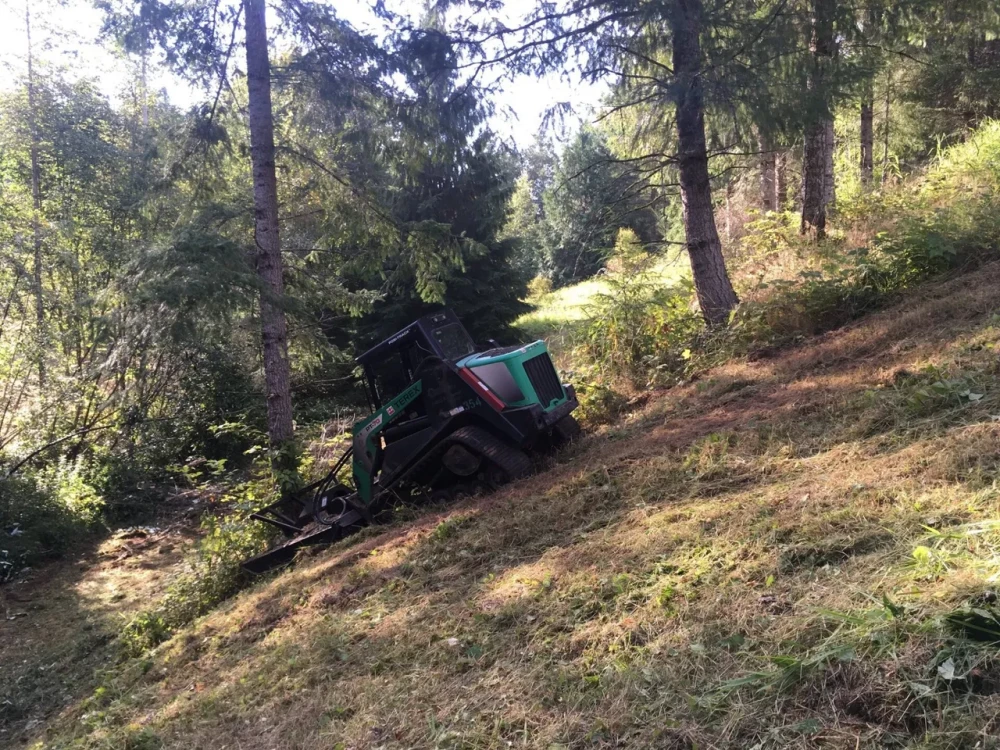
We cut the blackberry canes down using brush cutters, chainsaws, and machetes — whatever the thicket requires. All cut material is chipped on-site or hauled away.
Step 2: Expose & Grind the Root Crowns
This is the critical step most people skip. We expose the root crowns and grind them out. Without the root crown, the plant can’t regenerate. This is what separates a permanent solution from a temporary one.
Step 3: Site Cleanup
All debris — canes, roots, chips — is either chipped and spread as mulch (if appropriate) or hauled off-site. You’re left with clear, usable ground.
Step 4: Follow-Up Recommendations
Blackberries are persistent. Even after thorough root grinding, there will be some regrowth from seed and small root fragments. We’ll tell you what to watch for and how to stay on top of it — whether that’s spot-spraying, mulching heavily, or planting competitive native groundcover.
What Does Blackberry Removal Cost?
Pricing depends on the size and density of the infestation:
- Small patch (under 500 sq ft): $500–$1,000
- Medium area (500–2,000 sq ft): $1,000–$3,000
- Large area / property perimeter (2,000+ sq ft): $3,000–$8,000+
- Full-property reclamation (heavily overgrown lots): Custom estimate
The bigger the area, the more efficient the work — per-square-foot cost drops significantly on larger projects.
Common Blackberry Removal Scenarios
Property Line / Fence Line Clearing
Blackberries love fence lines. They grow through chain link, push over wood fences, and create impenetrable walls between properties. We clear along fence lines and give you access back.
Backyard Reclamation
That corner of the yard you gave up on three years ago? We clear it out completely and make it usable again.
Lot Prep / Pre-Construction
Building on a lot that’s been taken over by blackberries? We clear it down to bare ground, ready for construction.
HOA / Property Management
Common areas, empty lots, and neglected corners that have become blackberry jungles. We handle large-scale clearing for property managers and HOAs.
Trail & Access Clearing
Paths, trails, and access roads that have been swallowed by blackberry growth.
Can’t I Just Do It Myself?
You can try. Most people do, at least once. Here’s what you’re in for:
- It hurts. Himalayan blackberry thorns go through most gloves. You’ll bleed.
- It’s exhausting. Mature blackberry thickets are dense and woody — not something a string trimmer handles.
- It grows back. If you just cut the canes and don’t deal with the root crowns, you’ll be doing this again in 6 months.
- Disposal is a nightmare. Blackberry canes don’t fit in yard waste bins. They puncture garbage bags. They’re too thorny to bundle. You’ll need a trailer and a dump run — or several.
For small patches, DIY can work if you’re diligent about roots. For anything bigger than a parking space, call us. You’ll save yourself a lot of blood, sweat, and frustration.
Frequently Asked Questions
Will the blackberries come back?
Some regrowth from seed is normal — blackberry seeds can survive in soil for years. But without the root crowns, regrowth is manageable. We’ll give you a plan for long-term maintenance.
Do you use herbicides?
We can, if you want us to, but our primary method is mechanical removal and root grinding. For customers who prefer chemical-free removal, we offer fully mechanical options. For maximum long-term control, a targeted herbicide application on regrowth can be effective.
How long does blackberry removal take?
Small patches: a few hours. Large infestations: 1-3 days. Heavily overgrown lots: up to a week. We’ll give you a timeline with your estimate.
What can I plant to prevent blackberries from coming back?
Dense native groundcovers like salal, Oregon grape, sword fern, and snowberry can out-compete blackberry regrowth once established. Heavy mulching (4-6 inches of wood chips) also suppresses regrowth effectively.
When is the best time to remove blackberries?
Anytime, honestly. Late summer/early fall is ideal because the plants have spent their energy fruiting and are slightly weaker. But we remove blackberries year-round — there’s no bad time to get rid of them.
Ready to Get Started?
📞 Call: (425) 377-6012
Blackberry Removal & Property Restoration in Marysville & Snohomish County
Blackberry removal in Marysville, WA is one of our most requested services. We clear and grind them so they don’t return. Once gone, we help with the next step:
- Brush Clearing — clear all overgrown vegetation
- Land Clearing — full lot clearing for construction
- Tree Removal — remove trees hidden in the thicket
- Native Replanting — replace invasives with native plants
- Excavation — level the cleared area
Serving Marysville, Everett, Lake Stevens, Snohomish, Arlington, Stanwood, Monroe, Woodinville, Bothell, and all of Snohomish County. Request a free estimate or call (425) 377-6012.